Reptile & Amphibian UVB Lighting Guide: Everything You Need to Know
In this Article
Key takeaways
- UVB and heat are different things that do different jobs, and most reptiles and amphibians need both delivered by separate setups
- UVB lighting enables reptiles and amphibians to produce vitamin D3, which is what allows them to absorb calcium from their diet. Without it, metabolic bone disease is a real and preventable risk
- Glass and most plastics block UVB radiation: the bulb must be positioned so light passes through mesh or screen to reach your reptile or amphibian
- Replace UVB bulbs according to the manufacturer’s recommendations, even when the bulb still produces visible light, because UVB output fades well before the visible light does
- Always use a thermostat with any heat source and verify temperatures with a digital probe thermometer, not a stick-on thermometer
Setting up lighting and heating for a reptile or amphibian enclosure involves more components than most beginners expect. There are several different light and heat sources, each doing a specific job, and getting the combination right makes a significant difference to your reptile or amphibian’s long-term health.
This guide breaks down what each type of light and heat source does, when you need it, and how to set everything up correctly. For species-specific temperature and lighting requirements, how much heat and light do reptiles and amphibians need? and what climate does my reptile need? cover the specifics.
Why reptiles and amphibians need UVB
In the wild, diurnal (day-active) reptiles spend significant time basking in natural sunlight. That exposure does more than warm them up: it triggers a process in the skin that produces vitamin D3, which is what allows the intestines to absorb calcium from food. Without sufficient calcium absorption, reptiles and amphibians develop nutritional secondary hyperparathyroidism, more commonly known as metabolic bone disease (MBD). MBD is one of the most common and most preventable conditions in captive reptiles and amphibians.
Crepuscular and nocturnal species, including leopard geckos, are not exempt from this need. Even species that don’t actively bask in the traditional sense benefit from UVB exposure in captivity. Increasing evidence and many exotic veterinarians now recommend providing UVB lighting for virtually all reptile and amphibian species, including many nocturnal and crepuscular species, because it promotes natural vitamin D synthesis and may improve overall health. Species differ greatly in their UVB requirements, however, and some obtain more vitamin D3 from the diet than others.
UVB radiation falls in the 290 to 320-nanometer wavelength range. This is distinct from UVA (320 to 400nm), which supports behavioral functions like feeding activity, movement patterns, and normal daily rhythms. A good reptile or amphibian lighting setup provides both.
Modern reptile lighting recommendations are often based on Ferguson Zones, which group reptiles and amphibians according to the amount of natural UV exposure they receive in the wild. Species that spend long periods basking in direct sunlight require higher UV exposure than those that live under dense vegetation or are primarily active at dawn, dusk, or night. Many manufacturers and care guides now use Ferguson Zones to help match the correct UVB lamp to each species.
Understanding your lighting and heat options
Basking and heat lamps
A basking lamp is an incandescent or halogen bulb that produces both visible light and heat. It creates the warm basking spot that diurnal reptiles need to reach their preferred body temperature, digest food, and regulate immune function. Basking lamps are positioned at one end of the enclosure over the basking area, creating a warm side and a cooler side so your reptile can self-regulate by moving between zones.
Basking lamps produce light during the day and should be turned off at night. They do not produce meaningful UVB, so a separate UVB source is still needed alongside them for species that require it. Wattage depends on the size of the enclosure, the target basking temperature, and the distance from the bulb to the basking surface. Always check the temperature at the basking surface with a probe thermometer.
Ceramic heat emitters
A ceramic heat emitter (CHE) produces heat without any light, making it ideal for maintaining nighttime temperatures when you need warmth but not a light source. Reptiles rely on a day/night cycle, and bright light at night disrupts this. A CHE plugged into a thermostat maintains overnight temperatures without the light interference that colored “nighttime” bulbs can create. (Reptiles can see many of the wavelengths these bulbs emit, and they’re not recommended.)
CHEs run hot and require a ceramic bulb socket rated for heat, not a standard plastic socket. They should always be connected to a thermostat to prevent overheating.
Under-tank heat mats
Under-tank heaters (UTH) can be useful for some species and situations but should generally be considered supplemental heating rather than the primary heat source for most diurnal reptiles. A UTH should cover roughly one-third of the enclosure floor on the warm side, giving your reptile the choice to move on or off it as needed.
UTHs must be used with a thermostat and should not be the sole heat source for most species. They do not heat the air temperature within the enclosure. Placing anything that blocks airflow between the mat and the enclosure floor can cause dangerous heat buildup.
UVB fluorescent bulbs
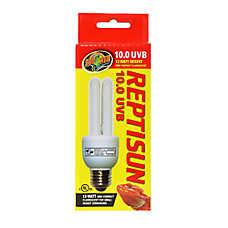
The T5 HO (high-output) fluorescent tube is the UVB source most commonly recommended by exotic animal veterinarians for many reptile and amphibian species. These bulbs produce the 290- to 320-nanometer UVB wavelengths reptiles and amphibians use to synthesize vitamin D3, along with UVA, which supports normal vision and natural behaviors such as feeding, activity, and reproduction. UVB lamps are available in different output strengths, commonly labeled as 5.0, 10.0, 6%, 12%, or similar depending on the manufacturer. These labels indicate the bulb's relative UVB output, not the UV Index your reptile actually receives. Higher-output lamps are generally used for species from open, sun-exposed habitats, such as bearded dragons, while lower-output lamps are better suited to species from shaded forests or those that are crepuscular. The appropriate bulb also depends on enclosure height, mesh screening, reflector quality, and the distance between the lamp and the basking area. Reflectors can significantly increase the amount of usable UVB reaching the basking area, making them, sometimes, an important part of an effective lighting setup. Important: UVB cannot pass through glass, most hard plastics, or solid covers. The bulb should be positioned so UVB reaches your reptile without a solid barrier. While mesh lids allow much more UVB to pass than glass, they still reduce UVB to varying degrees depending on the wire thickness and spacing. Always follow the bulb manufacturer's recommended mounting distance for your specific enclosure and species. PetSmart’s set-up guide for reptile habitats covers enclosure setup including lighting positioning.
Setting up lighting correctly
- Photoperiod: Run lights on a 12 to 14-hour daytime cycle with full darkness at night. Consistent day/night cycles support feeding, activity, immune function, and overall health. Ideally, lighting should be adjusted seasonally for species that naturally experience significant seasonal changes.
- Positioning: UVB bulbs should span at least two-thirds of the enclosure length. Position the basking light and UVB source so the basking zone receives both heat and UVB simultaneously, allowing your reptile to do both at once.
- Distance: UVB intensity drops significantly with distance but this can be helped with the use of reflectors on the fixture. Check the manufacturer’s recommendations for the appropriate distance between the bulb and your reptile’s basking surface for the specific bulb you’re using.
- Bulb replacement: The bulb may still produce visible light well past this point, but UVB output fades before visible light does. An old bulb that looks fine may be providing little to no effective UVB. It is recommended to replace UVB bulbs according to the manufacturer's recommended service life or after confirming declining output with a UV Index meter if one is available. Many modern T5 HO lamps remain effective for approximately 12 months, whereas some compact fluorescent lamps require more frequent replacement.
Thermostats and temperature monitoring
A thermostat is not optional. Every heat source in a reptile or amphibian enclosure should be connected to a thermostat that regulates output and prevents dangerous temperature spikes. An unregulated heat lamp or CHE can overheat an enclosure quickly, with serious consequences for the animals inside.
Verify temperatures with a digital thermometer with a probe placed directly at the basking surface and at the cool end of the enclosure. Stick-on thermometers are not accurate enough for this purpose. The temperature differential between the warm end and the cool end is what allows your reptile to thermoregulate, and both measurements need to be correct, not just one.
Common lighting and heating mistakes to avoid
- Relying on a single heat source without creating a thermal gradient from warm to cool across the enclosure
- Placing UVB bulbs over glass or plastic covers that block UVB from reaching the enclosure
- Not replacing UVB bulbs on schedule, leaving reptiles and amphibians with little to no effective UVB despite a functioning-looking bulb
- Using colored nighttime bulbs as a heat source, these are not recommended because reptiles can detect many of these wavelengths, disrupting their sleep cycle
- Skipping the thermostat on any heat source
- Measuring temperatures only at one point in the enclosure and assuming the gradient is correct without checking the other end