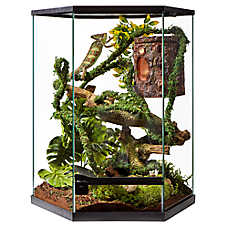
Crested Gecko Tank Setup: 20-Gallon Vertical Habitat Guide
In this Article
Key takeaways
- A 20-gallon tall enclosure is the established minimum for a single adult crested gecko; taller is always better for an arboreal species that spends most of its time off the ground
- Height matters more than floor space: a vertical orientation is essential, not just a preference
- Hatchlings and young juveniles do better in smaller enclosures (5 to 10 gallons) where they can easily find food and feel secure
- Dense climbing branches and cork bark hides at multiple heights are as important as the tank itself, a bare enclosure creates stress and contributes to floppy tail syndrome
- Humidity cycling, misting heavily and then allowing the enclosure to partially dry, is the best approach in most situations. Consistently wet conditions cause mold and respiratory problems
Crested geckos are one of the most popular and beginner-friendly reptiles available, and for good reasons. They’re hardy, handleable, and entertaining to watch. But setting up their habitat correctly, starting with the right tank orientation and filling it with appropriate climbing enrichment, makes a significant difference in how settled and healthy your gecko will be.
This guide walks through everything you need to build a proper 20-gallon vertical habitat for a crested gecko, from substrate to humidity to what to avoid.
Why vertical space matters for crested geckos
Crested geckos are arboreal, meaning they live in trees and spend the majority of their time off the ground. In the wild, they navigate branches, hunt insects in the canopy, and sleep tucked into foliage at height. In captivity, the height of the enclosure is what allows them to express those natural behaviors, while floor space matters relatively little.
This is why a 20-gallon “tall” or “high” tank is what you want, not a 20-gallon “long” of the same volume but oriented horizontally. A standard 20-gallon tall is typically around 24 inches high, the acceptable minimum. Front-opening enclosures designed for arboreal reptiles are even better: they allow access without reaching from above, an approach direction that mimics a predator.
Is a 20-gallon right for your gecko?
Enclosure size should match the gecko’s life stage, and the 20-gallon is specifically the adult standard.
- Hatchlings (under 3 to 4 months): A small deli cup, a 5-gallon tank, or a shoebox-style enclosure is more appropriate. Very young geckos can struggle to locate food in a large enclosure, which creates stress and can affect feeding response.
- Juveniles (4 to 12 months): A 10-gallon tall enclosure works well as an intermediate step before the full 20-gallon.
- Adults (12 months and older): A 20-gallon tall is the established minimum for a single adult. Larger is better. An 18” × 18” × 36” front-opening enclosure is a commonly recommended upgrade that gives a mature gecko significantly more usable vertical space.
Never house two male crested geckos together: they will fight and cause serious injury. A single male can be housed with females in a large enclosure, but breeding should be expected. Multiple females can coexist in a spacious, well-furnished setup.
Setting up the habitat
Substrate
For hatchlings, paper towels are the safest and most practical substrate. They’re easy to change, allow you to monitor waste, and eliminate any ingestion risk during feeding.
For juveniles and adults, coconut coir, organic topsoil, sphagnum moss, or a mix of these holds humidity appropriately and supports wet/dry cycling. A two to three-inch depth works for most setups. Avoid commercial potting soils with fertilizers or additives.
Climbing structure and branches
This is where many beginner crested gecko setups fall short. A single branch in an otherwise open enclosure is not enough. A well-set-up crested gecko habitat should feel densely furnished at every height level: branches and vines for horizontal movement, cork bark rounds or tubes for hiding and resting vertically, and a clear path from the lower level to the upper areas of the enclosure.
Dense, multi-level climbing structures directly reduce the risk of floppy tail syndrome, a spinal deformity that develops when geckos chronically sleep pressed flat against smooth glass without adequate perches to support their body weight. If your gecko is always sleeping on the glass walls, they don’t have enough perching options at the height they prefer.
Hides and cover
Cork bark tubes and hollows placed at both upper and lower levels provide the covered retreats crested geckos need to feel secure. A gecko without adequate hides will spend most of its time pressed into corners. Live or artificial plants fill the spaces between structural elements, add visual cover, and make the enclosure more naturalistic. Pothos is the go-to live plant: hardy, humidity-tolerant, and safe for the species. Silk plants work well as a lower-maintenance alternative.
Feeding station
Crested gecko diet (CGD) is the nutritional foundation for most captive crested geckos. Offer it in a small cup or on a magnetic or suction ledge at mid-to-upper height, where the gecko spends most of its active time. Supplemental live feeders like small crickets or Dubia roaches can be offered a few times a week. Remove uneaten insects after a few hours.
Temperature and humidity
Crested geckos thrive in a relatively cool, narrow temperature range. Daytime temperatures should stay between 72 and 78 degrees Fahrenheit, dropping to 65 to 72 degrees at night. Most homes maintain this range naturally, which is one reason crested geckos work well for beginners.
Temperature above 82 to 85 degrees Fahrenheit is stressful and potentially dangerous. Unlike desert reptiles that tolerate high basking temperatures, crested geckos have a low upper thermal limit. If your home gets warm in summer, monitoring your enclosure temperature and providing supplemental cooling (air conditioning, a fan near the enclosure without directing airflow directly at it) is more important than providing heat.
For humidity, target 60 to 80% during misting and 40 to 60% between cycles. Mist once or twice daily with clean, room-temperature water, ideally in the evening. Allow the enclosure to partially dry between mistings: consistently wet conditions promote mold and bacterial growth. A digital hygrometer and thermometer placed inside the enclosure is how you verify both conditions accurately.
Lighting
Ambient room lighting or a low-output fluorescent or LED bulb on a 12 to 14-hour cycle maintains a normal day/night pattern and supports live plants. The UVB question for crested geckos has evolved: they were raised for generations in captivity without UVB, but more recent research indicates they can utilize low-level UVB for vitamin D3 synthesis. A low-output UVB bulb (2.0 or 5.0%) is now considered a beneficial addition by many exotic veterinary professionals. If you include one, follow standard replacement schedules and ensure it isn’t blocked by glass or hard plastic. Consult your exotic vet for guidance specific to your setup.
Common mistakes to avoid
- Starting with too large an enclosure: A hatchling in a 20-gallon will struggle to locate food. Scale the enclosure to the gecko’s size.
- Insufficient perches and climbing structure: A sparsely furnished tank is one of the most common setups and one of the least appropriate. Fill vertical space at every level.
- Overheating: Crested geckos have a low upper temperature limit. A setup appropriate for a desert reptile can be dangerous here. Monitor closely in warm months.
- Continuous high humidity: Misting heavily and never allowing the enclosure to partially dry promotes mold, bacterial infections, and respiratory problems. The wet/dry cycle is essential.
- Housing two males: Even in a large enclosure, males will eventually fight. House males separately.
- Using a horizontal tank: A standard 20-gallon long oriented horizontally eliminates most of the usable space for an arboreal gecko. Always prioritize height.