

Best Dog Halloween Costumes 2026
In this Article
Best Dog Halloween Costumes 2026: How to Choose One That Fits and Stays On Key takeaways
Let’s be honest: dog Halloween costumes are one of the great joys of pet parenthood. From a French Bulldog as a tiny pumpkin, to a Great Dane dressed as a horse, there are countless hilarious and wonderful options. And the good news is that Halloween costumes can be a fun experience for dogs too, when they’re chosen thoughtfully and introduced the right way. This guide covers how to find a costume that fits well and stays on, how to make sure your dog is actually comfortable (not just tolerating things), popular ideas for different sizes and breeds, and the Halloween safety basics that are easy to overlook when you’re focused on getting the perfect photo.
How to choose the right costume: fit first
The most common dog costume mistake is prioritizing appearance over comfort. A costume that’s beautiful on the hanger but restricts movement, limits vision, or prevents your dog from panting effectively is not a good costume for your dog, no matter how cute it looks. The fit checklist to run through before you buy:
- Breathing: Nothing covering the nose or mouth. Brachycephalic breeds (French Bulldogs, Pugs, English Bulldogs, Boston Terriers) already have compromised airways, and any additional restriction is a safety concern.
- Vision: No hats, hoods, or headpieces that fall forward over the eyes. Your dog needs to see where they’re going.
- Movement: Your dog should be able to walk, sit, lie down, and turn around naturally. Test this with the costume on before the event.
- Bathroom access: Nothing that prevents your dog from squatting or lifting a leg. This sounds obvious but is more often an issue than you’d expect.
- No small parts: Buttons, decorative elements, or dangling accessories that could be chewed off and swallowed should either be secured very well or avoided. Dogs interact with costumes with their mouths.
- Material: Soft, breathable fabrics are more comfortable than stiff or synthetic materials. Elastic bands or ties should be snug enough to stay on but not tight enough to restrict circulation.
Measure before you buy. Most dog costume size guides use chest girth, neck girth, and back length. Take your measurements with the dog standing and cross-reference them with the specific sizing chart for the costume you’re considering, since sizing varies by brand. Browse dog Halloween costumes in the PetSmart Dog Shop to find options with sizing guidance.
Reading your dog’s body language
Not every dog loves costumes, and that’s completely okay. Some dogs tolerate them with a mild, dignified air of dignity. Others are genuinely unbothered and keep playing normally. And some dogs find costumes genuinely stressful, and those dogs shouldn’t be pushed into them for the sake of the photo. Signs a dog may be uncomfortable:
- Freezing or refusing to move (the “statue” response)
- Panting more than the temperature or activity warrants
- Tail tucked under, ears flat, hunched posture
- Pawing at the costume or trying to shake it off
- Yawning, lip licking, or turning away repeatedly
- Refusing treats they would normally take
If your dog shows these signs consistently when in the costume, even after a gradual introduction, the costume isn’t working for them. A festive bandana or a Halloween-themed collar is a completely valid alternative that many dogs tolerate much more comfortably.
Introducing the costume: take the slow road
The single most effective thing you can do to make a dog comfortable in a costume is to introduce it gradually, over several days before the event, rather than pulling it out on Halloween night.
A simple progression that works for most dogs:
- Day 1–2: Let the costume sit near your dog’s bed or food area so it becomes a familiar smell. Treat your dog near it. No pressure to interact.
- Day 2–3: Hold the costume up near your dog, offer treats, and reward any calm sniffing or approaching. Associate the costume with good things.
- Day 3–4: Drape the costume over your dog briefly without fastening it. Treat generously. Keep the session very short and end positively.
- Day 4–5: Fasten the costume loosely for a minute or two while your dog eats a treat or does something they enjoy. Gradually increase the duration.
- Day 5–6: A full, short session in the costume with the dog walking around, getting treats, and playing normally.
This process sounds like a lot, but it genuinely changes the experience for dogs who are initially hesitant. A dog who associates the costume with high-value treats and good attention is a much happier participant than one for whom the costume is simply imposed.
Costume ideas by size and breed
Small dogs (under 20 lbs)
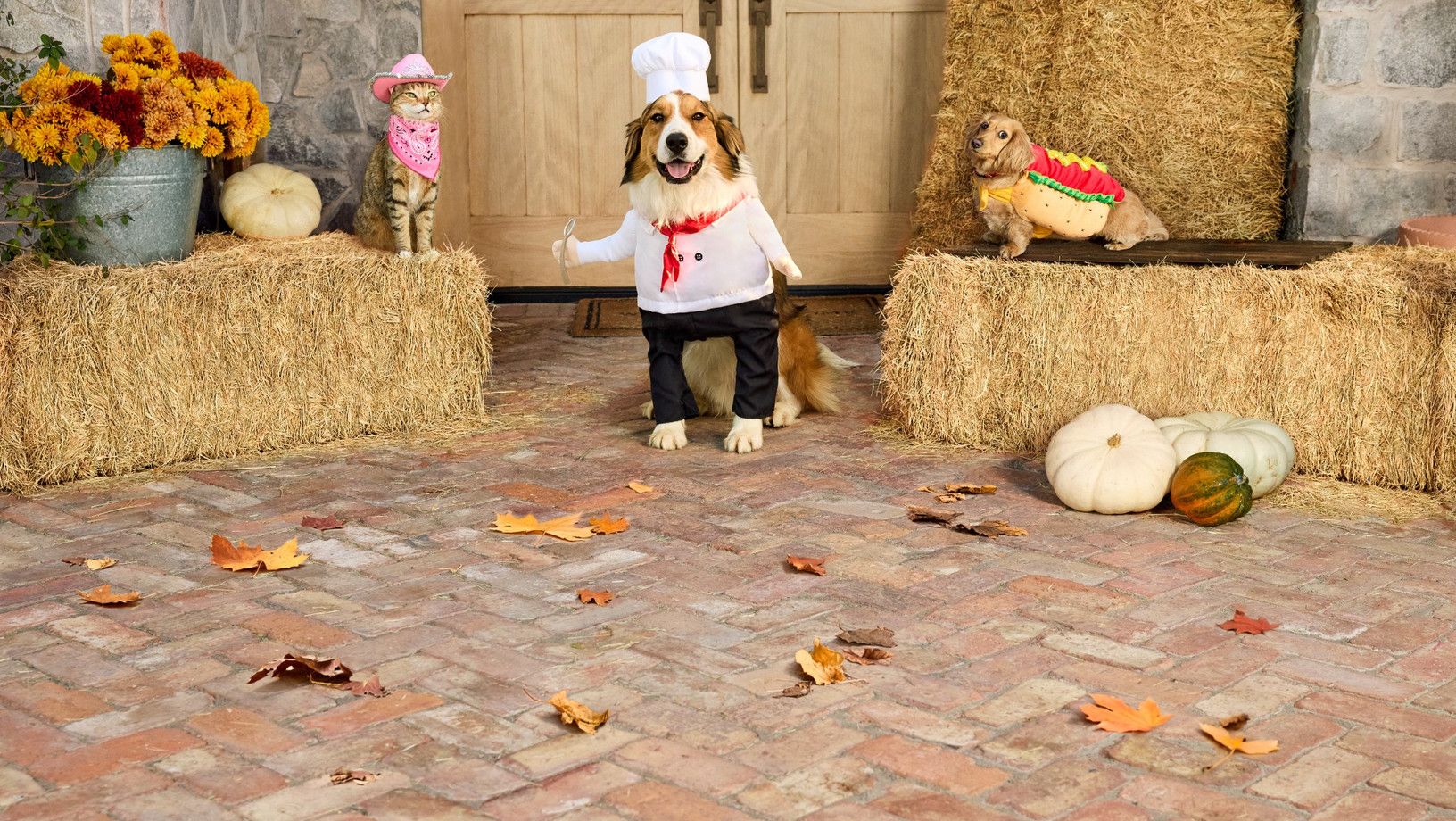
Small dogs like Chihuahuas, Dachshunds, Yorkshire Terriers, and small Poodles often photograph beautifully in elaborate costumes because even a full outfit doesn’t weigh much relative to their body. Popular ideas that tend to fit well on small dogs include food costumes (a taco, a hot dog, a sushi roll), characters with hoods or hats that frame their small faces, and themed pet-and-person coordinating costumes. Dachshunds deserve their own mention here. The long-body, short-legs physique makes them naturals for anything that plays on their shape, a hot dog is the classic, but also a submarine, a caterpillar, or a dinosaur works wonderfully.
Medium dogs (20 to 60 lbs)
Labs, Beagles, Corgis, Bulldogs, and Border Collies land in this range. Medium dogs have the most options because most retail costume sizing is built around this range. Classic crowd-pleasers: superheroes, classic movie characters, animals, and profession costumes (firefighter, chef, astronaut). Corgis in particular look extraordinary as bees or as royalty, possibly because they are royalty.
Large dogs (over 60 lbs)
Finding well-fitting costumes for large dogs requires more sizing attention, but the payoff is spectacular. A Great Dane as a horse or a giraffe, a Bernese Mountain Dog as a bear, a Husky as a wolf, the larger the canvas, often the better the effect. Look for costumes with XL or XXL sizing that’s proportioned for larger frames, not just stretched from medium sizing.
Flat-faced breeds
French Bulldogs, Pugs, Bulldogs, and Boxers look magnificent in practically anything, but their airway anatomy means any costume needs to keep the face clear. Avoid full head costumes or anything that adds bulk around the neck. A cape, a onesie, or themed apparel that stops at the collar line works well and keeps them comfortable.
Halloween safety while out and about
If your dog is coming trick-or-treating or to a Halloween event, a few practical safety notes:
- Use a leash: Even well-trained dogs can be startled by unusual costumes, sudden crowds, or unexpected sounds. Keep your dog leashed and use a well-fitted harness rather than a collar-only setup if your dog is prone to pulling.
- Go reflective: Evening trick-or-treating means low light. Reflective or LED collar and leash options make your dog visible to cars and cyclists. A light-up collar is a simple upgrade with a real safety benefit.
- Watch the candy: Chocolate, xylitol (found in sugar-free candies and gum), raisins, and macadamia nuts are all toxic to dogs. Keep the candy bag well out of reach and brief anyone your dog will be around.
- Know your dog’s limit: A busy trick-or-treat route with lots of strangers in unfamiliar costumes may be more than some dogs enjoy, even dogs who are generally social. If your dog is showing signs of being overwhelmed, heading home early is the right call.
- ID and microchip: Make sure your dog’s tags are current and their microchip registration is up to date before any Halloween event. Startled dogs can bolt.
Tips for keeping the costume on
The most common Halloween costume complaint is “my dog keeps shaking it off.” A few things that help:
- Fit the costume snugly but not tightly. A loose costume is more uncomfortable than a correctly fitted one and is more likely to slide, fall, and be removed.
- If the costume has a hat or headpiece that your dog consistently removes, consider skipping that element and focusing on the body piece, which most dogs tolerate better.
- Distraction works: keep your dog engaged with treats, attention, and activity. A dog who is focused on something fun is less likely to be focused on the thing they’re wearing.
- Short sessions. You don’t need the costume on for three hours. The photo window and the trick-or-treating highlights are probably 30 to 45 minutes. Keep it manageable.
Accessories and coordinating ideas
If a full costume isn’t the right fit for your dog, accessories get you a lot of the fun with less of the drama. Halloween-themed bandanas and bow ties are widely available, universally tolerated, and genuinely charming on most dogs. A festive collar or a themed harness overlay are other low-intensity options. For the households doing coordinating pet-parent-and-dog costumes, the best setups lean into the pairing: a hot dog and its bun (dog as the hot dog, obviously), a superhero and their sidekick, a ghost and a pumpkin. The comedy of a matching human-dog costume is a distinct and wonderful category of Halloween experience.
Browse dog Halloween costumes and accessories at PetSmart to shop the full seasonal collection.
Information in this article is not intended to diagnose, treat or cure your pet and is not a substitute for veterinary care provided by a licensed veterinarian. For any medical or health-related advice concerning the care and treatment of your pet, contact your veterinarian.


