Cat Costumes: Styles Cats Will Actually Tolerate Wearing
In this Article
Key takeaways
- Most cats are not costume cats, and the ones who are tend to be cats who have been handled extensively from kittenhood. That’s the baseline expectation to set before shopping
- Back length and neck girth are the two most important measurements for most cat costume styles
- Flat-faced breeds (Persians, Exotic Shorthairs, Himalayans) need the same airway-first consideration as brachycephalic dogs: nothing around the face or neck that adds restriction
- Introduce any costume over multiple days with treats. A costume introduced in five minutes on the day of an event is a costume your cat will spend the event trying to remove
Here’s the honest version: cats are harder to costume than dogs. Where a patient, food-motivated dog might warm up to a full outfit with a few days of positive reinforcement, the average cat has a narrower tolerance window and less interest in cooperating for your vision. That doesn’t mean cat costumes aren’t worth pursuing, it means going in with the right expectations and the right products.
The cats you see in fully dressed Halloween photos are real cats who genuinely don’t mind. They exist. Your cat may or may not be one of them. This guide helps you figure that out and find the option that works for whoever your cat actually is.
Is your cat a costume cat?
The fastest predictor is how your cat responds to handling generally. A cat who tolerates nail trims without drama, doesn’t object to being picked up and positioned, and takes treats during stressful moments is a more promising costume candidate than one who runs at the sight of a carrier.
A simple test before you buy anything: drape a lightweight dish towel across your cat’s back and observe. A cat who shakes it off immediately and exits the room is giving you useful data. A cat who sniffs it, moves around normally, and keeps going about their business is telling you something different.
Signs a cat is not tolerating a costume well:
- Freezing completely or moving in an exaggerated low crouch
- Ears pinned flat or rotated sideways
- Tail lashing or puffed
- Attempting to shake, roll, or claw the item off immediately
- Refusing treats they would normally take readily
Any of these signals during or after introduction means the costume isn’t working for this cat. A Halloween bandana or a seasonal collar is a legitimate and charming alternative, and it’s one most cats tolerate with minimal objection.
How to measure your cat for a costume
Measuring a cat requires a second person or a very patient cat. Use a soft tape measure and take measurements with your cat standing:
- Back length: From the base of the neck to the base of the tail. The single most important measurement for any body-covering costume.
- Neck girth: Around the base of the neck, where a collar sits. Critical for anything with a collar attachment, cape, or neckline.
- Chest girth: Around the widest part of the chest, just behind the front legs. Needed for full-body costume styles.
As with dog sizing, cross-reference your specific cat’s measurements against the chart for the exact product you’re buying. Cat sizing is less standardized than dog sizing, and a “small” in one brand may not translate to another. If your cat is between sizes, go up.
Styles ranked by tolerance: most to least
Not all cat costumes ask the same thing of a cat. Here’s how common styles tend to rank by how widely cats accept them:
1. Collar accessories and bandanas
The most universally tolerated option. A Halloween-themed collar, a small bow tie attachment, or a bandana tied loosely at the neck asks very little of the cat and delivers a lot of seasonal charm. Most cats who wear a regular collar will accept a decorative version without protest. For cats who don’t wear collars, a bandana is worth trying separately.
2. Lightweight capes
A cape that attaches at the collar level without touching the body is the next step up in coverage and still tends to be well-received by cats who are comfortable with handling. The cape moves with the cat, doesn’t restrict their legs or belly, and can be removed quickly if needed. A vampire cape on a black cat is one of the most efficient Halloween costume formats for both parties.
3. Minimal hats and headpieces
Hats are genuinely hit or miss, and mostly miss for sustained wear. What they’re reliable for is a brief photo moment: position the hat, offer a treat in front of your cat to hold their attention for a few seconds, take the photo, remove the hat, reward generously. This is portrait mode, not costume day. Elastic chin straps are worth avoiding: the sensation is unfamiliar and cats typically object to anything touching their chin.
4. Lightweight full-body costumes
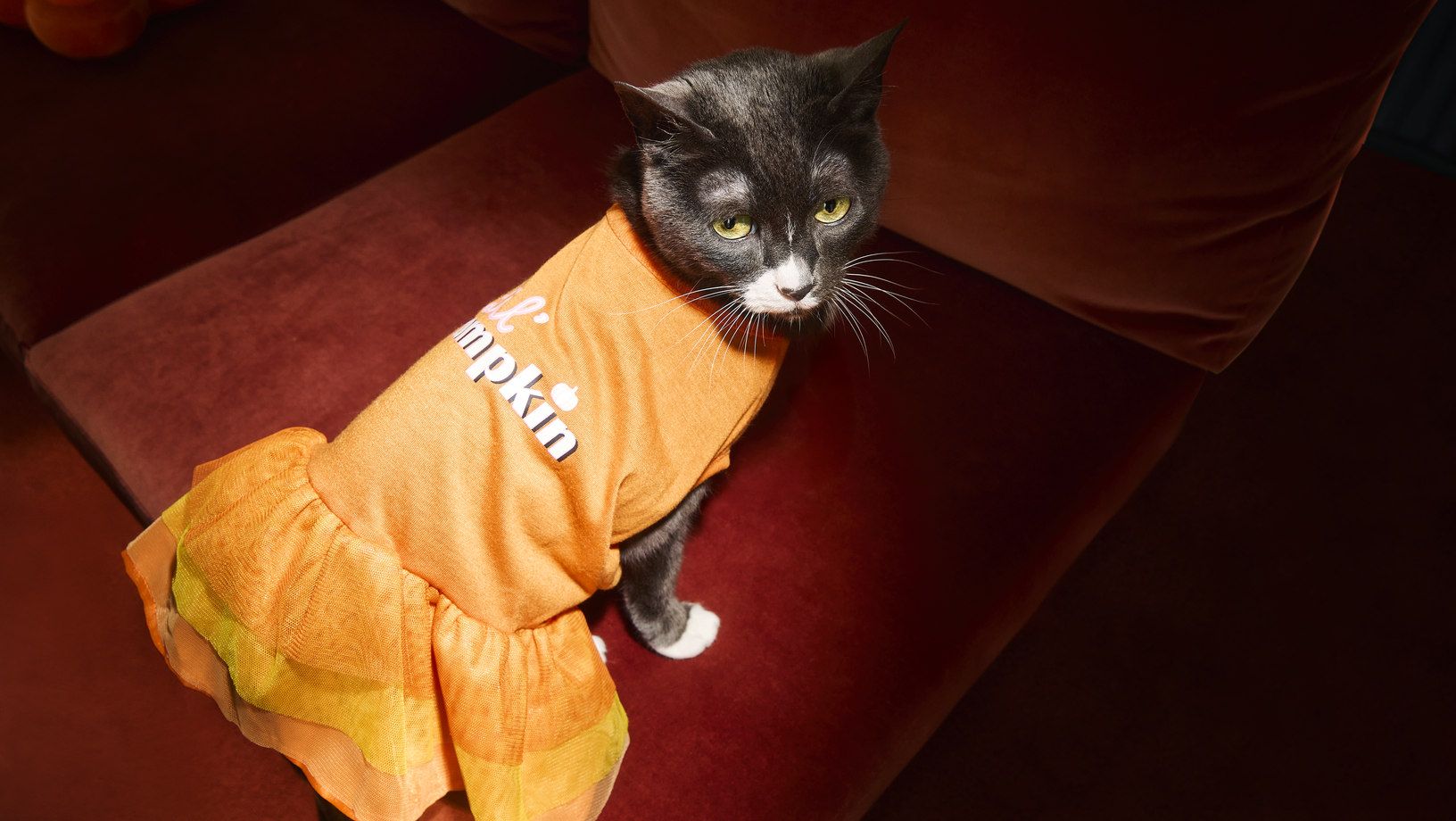
For cats who genuinely tolerate wearing things, a lightweight fabric costume that slips over the body without tight closures or leg components can work. The key word is lightweight: heavy, structured, or padded costumes are almost never well-received by cats regardless of how patient they are. A simple fabric tube with a character design, the style of costume that slips over the head and rests on the back, tends to be the most tolerable full-body option when it fits correctly.
5. Elaborate costumes with leg elements
Full costumes with individual leg coverings, multiple fastening points, or structural elements are the least widely tolerated by cats. Some cats accept them. Most don’t. If you’re buying this style, have a backup option ready and introduce it over significantly more time than a simpler costume would require.
Safety checklist for any cat costume
- Clear airway: Nothing covering the nose or mouth. Nothing that adds restriction around the neck beyond a well-fitted collar-level attachment.
- Full vision: Your cat must be able to see in all directions. Anything that falls forward into their field of vision causes disorientation and anxiety.
- Unrestricted movement: Your cat should be able to walk, jump, groom their face, and land normally from a jump. Test this before the event.
- No small parts: Cats investigate things with their mouths. Any detachable decorative element is a swallowing risk.
- Lightweight material: Cats overheat in heavy costumes. Breathable, light fabric is always preferable.
- Supervised at all times: Never leave a cat unattended in a costume. Cats are resourceful about removing things, and a partially removed costume can become a tangle hazard.
How to introduce a costume
The five-day framework that works for dogs applies to cats too, with the caveat that cats often need even more time and more patience at each step:
- Day 1: Leave the costume near your cat’s favorite spot. No interaction required.
- Day 2: Hold it near your cat and offer a treat. The item equals good things.
- Day 3: Rest it on your cat’s back for a few seconds without fastening. Treat immediately, then remove before they object.
- Day 4: Fasten it briefly while your cat eats a treat. Under a minute. End positively.
- Day 5: A short full session with your cat moving around in the costume, with treats throughout.
If your cat protests at any step, slow down rather than push through.
Considerations by cat type
Flat-faced breeds: Persians, Exotic Shorthairs, Himalayans
The airway consideration that applies to brachycephalic dogs applies equally here. Flat-faced cats have a similar respiratory anatomy and should never wear anything that adds restriction around the face or neck. Collar accessories and bandanas at a comfortable fit are the safest options for these breeds. Watch for any increased breathing effort or open-mouth breathing during wear and remove the costume immediately if either occurs.
Hairless breeds: Sphynx, Peterbald
Hairless cats are actually sometimes more tolerant of lightweight clothing than coated cats, partly because they run warmer and partly because they’re accustomed to wearing sweaters or shirts in cooler environments. A snug-fitting lightweight costume may be genuinely comfortable for a Sphynx who is already used to wearing clothing. Introduce the same way regardless. Avoid anything that causes their skin to bunch, rub, or restrict movement.
Large breeds: Maine Coons, Norwegian Forest Cats, Ragdolls
These cats are significantly larger than typical sizing assumes. A Maine Coon can weigh 18 to 20 pounds or more. Standard cat sizing rarely fits. Look for XL cat sizing or small dog sizing, measuring back length and chest girth carefully. The proportions of large breeds (long body, deep chest, substantial neck) are different from the proportions most cat costumes are built around.
Domestic shorthairs and longhairs
The most adaptable group, and the cats most costume options are designed for. Standard sizing tends to apply reliably. Longhaired cats may find costumes that press against their coat uncomfortable if the fabric catches or bunches. Smooth, lightweight materials work better than textured ones for longhaired cats.